-
Auditude and Inlet Partner for Ads In Live Flash Streams
Ad manager Auditude is partnering with Inlet Technologies to deliver an automated ad insertion solution for live video streaming using Flash. The move means that media companies can better monetize live streaming events which have more complex ad insertion and management characteristics than do on-demand streams. Under the arrangement, Inlet's Spinnaker streaming appliances can detect cues from Auditude's ad manager in order to insert the right ads at the right time.
Serving ads in live streams has been a differentiator for Auditude, helping it recently land its first Asian deal with Allies Pacific Sports Network which has the rights to stream MLB games in various Asian countries. The deal was similar to one which Auditude has with Yahoo for MLB games domestically. Live streaming as a whole is growing rapidly and offers another exciting online video distribution opportunity for rights holders. The proliferation of both connected devices (allowing on-TV viewing) and mobile devices (allowing on-the-go, remote viewing), both suggest even broader appeal for live streaming events.
Still, with its unpredictable ad breaks with inconsistent durations, inserting ads in live streams is a new challenge. By helping ease the operational complexity and improve the ROI of live streaming, Auditude and Inlet will help the market grow.
What do you think? Post a comment now (no sign-in required).
Categories: Advertising, Live Streaming, Technology
-
AdoTube Data Suggests Video Ads Benefit From Viewer Control
AdoTube, an online video ad manager and network is releasing data on the performance of its "Polite Pre-Roll" and interactive ad formats this morning, which provide more insight about viewers' behaviors and preferences. AdoTube's Chief Strategy and Operations Officer Steven Jones walked me through the results yesterday.
AdoTube began offering the Polite Pre-Roll format last year to clients and has done A-B testing on it vs. standard pre-roll ads on 30 million servings. With the Polite Pre-Roll, viewers are able to click to close the ad, and then a reminder overlay appears at the bottom of the screen, which also can be closed out. In addition the Polite Pre-Roll has far deeper engagement opportunities than standard pre-rolls.
Categories: Advertising
Topics: AdoTube
-
Magnify.net Lands Patagonia As Video's Role Broadens to Supporting Brands
Magnify.net, a provider of video management and curation services, is announcing later this morning that its platform will be used by Patagonia, the outdoor clothing and gear company, to power a new multimedia gallery on its site.
The video-focused initiative will highlight Patagonia's commitment to environmentalism and reinforce its brand positioning. In explaining the gallery's role and using Magnify, Bill Boland, Patagonia's creative director, online, said, "Together, we expect to build a brand, lifestyle and e-commerce experience that will connect with our customers and provide both knowledge and entertainment for them." The deal is significant because it's yet another example of how video's use is evolving to include non-media companies who see video's strategic video in supporting their brands, not in the traditional ad-based or paid models. I caught up with Steve Rosenbaum, Magnify's founder and CEO yesterday to learn more about the deal and this broader trend.
Categories: Brand Marketing, Technology
Topics: Magnify.net, Patagonia
-
Verizon Wireless: Buy a Droid Incredible, Get Any Smartphone Free
Raising the bar on Android smartphone promotions further, Verizon Wireless just started a campaign where if you buy an HTC Droid Incredible for $200, you get any other smartphone or phone of equal or lesser value for free (caveat, it must also have a 2-year $30/mo data plan). The offer means that you can get a new top-of-the-line Samsung Galaxy S Fascinate for free. I noticed a full-page ad for the promotion in the Boston Globe, and Verizon Wireless is also running TV ads (below).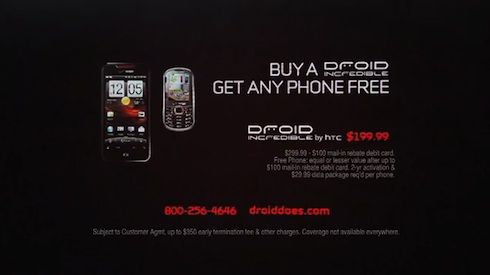
One of the big reasons why Android smartphones are proliferating so fast is wireless carriers' promotional support. The result is that millions of users are now carrying video-capable smartphones, in turn fueling mobile video consumption. Samsung in particular has positioned the Galaxy S line heavily around video, and you've likely seen an ad(s) with the spectacular "Super AMOLED" screen on full display. The iPhone has also emphasized video, but the Android push is significant because once version 2.2 is fully available, Flash 10.1 will run, opening up a huge swatch of Flash-formatted video that isn't accessible on the iPhone (or iPad).
The expanding base of video-capable smartphones, coupled with upcoming 4G rollouts, has huge potential for transforming the video landscape. Especially for young people, the notion of video being locked to a big-screen TV will be as out of date as black-and-white TV was for a prior generation. Add in all the activity around tablet computers and things only get more interesting.
Update: No sooner did I post this than Nielsen released new data that of people acquiring smartpohones in the last 6 months, Android led with a 32% share, followed by iPhone and Blackberry at 25-26%.
What do you think? Post a comment now (no sign-in required).
Categories: Advertising, Mobile Video
-
Netflix, HBO, Others Coming to Google TV
Google released further details on Google TV this morning, unveiling a slew of content services and apps that will be available at launch. Chief among them are Netflix and HBO Go (both for subscribers), Amazon VOD and Pandora, plus new apps from NBA ("NBA Game Time"), NBCU ("CNBC Real-Time"), and "optimized" content from Turner Broadcasting, NY Times, USA Today, VEVO, Napster, Twitter and blip.TV. Google didn't specify what optimized means, but I suspect it means appropriate metadata so that programs can be exposed in Google TV searches. Of course, "Leanback," YouTube's 10-foot interface, will also be featured.
Categories: Devices
Topics: Amazon, blip.TV, Google TV, HBO, Logitech, Napster, NBCU, Netflix, NY Times, Pandora, Turner, Twitter, USA Today, VEVO
-
Another $150M Raised by Video Companies in Q3 '10, Plus Lots of Deals
Q3 '10 saw strong continued investment interest in the online video industry, with at least 14 private companies raising at least $149.4 million, according to sources I track. The largest amount however, $50 million, went to Chinese video portal Tudou. If that amount were backed out, then the approximately $100 million remaining would actually be the lowest quarterly total since Q2 '09. Total financings over the last 4 quarters are approximately $756.1 million.
The big news of the quarter though, was in industry deals. At least 11 acquisitions were announced or completed in Q3, which are listed after the investments below. In other industry news, Blockbuster declared bankruptcy, capping its long demise, and rumors of Hulu's plans to go public surfaced.
Following are the financings and acquisitions that I tracked during the quarter, the date disclosed and new investors identified if applicable. Links are provided to the companies' press releases, or to relevant media coverage if none could be found (note that I haven't verified media coverage with companies themselves). If I've missed anything or you find an inaccuracy, please post a comment.
Categories: Deals & Financings
Topics: Deals
-
HealthiNation Adds Doug McFarland as Chief Digital Officer
HealthiNation, an independent provider of health-related online videos, is announcing this morning that online industry veteran Doug McFarland has joined as Chief Digital Officer to oversee digital strategy and operations. McFarland was previously co-CEO of Dimestore Media (acquired by Knowledge Networks), CEO of online video ad network ScanScout, EVP/GM of Eyeblaster and EVP/GM of Advertising.com. He's also been on HealthiNation's board for the last two years.
Categories: Indie Video, People
Topics: HealthiNation
-
Nielsen: iPad Already In 3.6% of U.S. Homes in Q2. How's That Compare?
I was checking out Nielsen's Q2 '10 Home Technology Report findings and one stat jumped out at me: 3.6% of U.S. homes now own an iPad. The percentage would actually be a little higher than Apple's own data given that it reported 3.27 million iPads sold in the quarter ending June 26th (assuming there are approximately 110-115 million U.S. households).
Either way, when you think of iPad sales in household penetration terms, the question that comes to mind is how long after their introductions did digital products and services like DVR, HDTV, broadband Internet, VOD and others reach 3.6%? I don't know the answer, but I suspect it was far longer than a single quarter.
With Apple's next quarter performance due on Oct. 18th, we'll see how many more millions of iPads were sold in the 3rd calendar quarter of 2010. And of course with Q4, the holiday quarter, now underway, the biggest wave of purchases is just ahead. At some point it will be fascinating to overlay the iPad's early years' quarterly household penetration curve on other digital products and services. No doubt it will tell a remarkable story of success.
What do you think? Post a comment now (no sign-in required).
Categories: Devices
VideoNuze Posts

Connect with VideoNuze
Exclusive News Roundup
- Netflix Pushes Further Into Live Programming With ‘The Breakfast Club’ WSJ
- Roku builds dedicated creator content hub, expands FAST channels StreamTV Insider
- Amazon, Netflix and Google to Capture Half of CTV Ad Market by 2030 TV Tech
- YouTube's AI deepfake detection tool is now available to all creators 18 and older Engadget
- Paramount’s Warner Bros. Takeover Expected To Breach Its SkyShowtime Venture With Comcast Deadline
- Netflix Says Its Ad-Supported Tier Now Has 250 Million Monthly Viewers Cord Cutters News